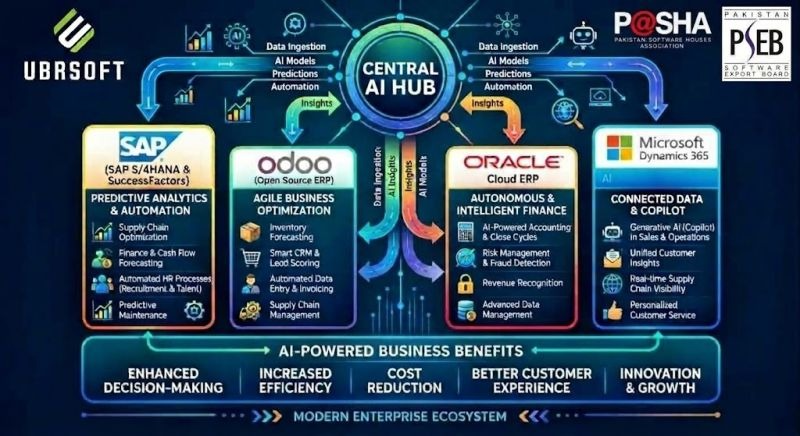
From Managing Data to Making Smarter Decisions
In today’s fast-moving business world, managing operations efficiently is more important than ever. Companies deal with large amounts of data every day, from sales and inventory to finance, human resources, and customer relationships. Keeping everything organized is important, but using that information to make better decisions is what truly makes a difference.
This is where Enterprise Resource Planning (ERP) systems come in.
For years, ERP software has helped businesses manage their daily operations, maintain records, and bring different departments together on a single platform. However, traditional ERP systems have often depended on people to analyze reports, identify problems, and decide what to do next.
Artificial Intelligence (AI) is changing this approach.
By integrating AI into ERP systems, businesses can move beyond simply recording what has happened. They can identify patterns, anticipate potential problems, automate repetitive tasks, and make more informed decisions about the future.
Whether you choose global ERP solutions like SAP and Odoo or ERP software in Pakistan built for local businesses, AI is what turns stored data into smarter decisions.
Let’s explore how AI is transforming some of the leading ERP platforms and what this means for modern businesses.
1. SAP: Making Enterprise Operations More Predictable
SAP is widely used by large organizations to manage complex business operations. With AI-powered capabilities, businesses can gain deeper insights into their financial performance, supply chains, procurement, and workforce management.
For example, an AI-enabled ERP system can help identify unusual spending patterns, highlight potential supply shortages, and improve demand forecasting. Instead of discovering a problem after it affects operations, managers can receive earlier warnings and take preventive action.
The result is better planning, improved visibility, and more informed business decisions.
2. Odoo: Helping Growing Businesses Work Smarter
Odoo has become a popular choice for businesses looking for a flexible ERP solution that brings multiple business functions together.
When combined with AI and machine learning tools, Odoo-based solutions can help businesses improve inventory forecasting, automate document processing, prioritize sales leads, and reduce repetitive administrative work.
Imagine a business that regularly runs out of its best-selling products. With suitable AI integration, its ERP system could analyze historical sales, seasonal trends, and current stock levels to help the purchasing team plan ahead.
For growing businesses, this means less manual work, better control over resources, and more time to focus on customers and growth.
The exact capabilities depend on the Odoo version, installed applications, and integrations being used.
3. Oracle Cloud ERP: Bringing Intelligence to Financial Management
Financial management is one of the most important areas of any organization, and even small errors can create significant challenges.
Oracle Cloud ERP incorporates AI capabilities designed to support financial processes, automate routine activities, and provide useful insights into business performance.
For example, AI-assisted systems can help process financial information, identify unusual transactions, highlight discrepancies, and support faster reporting. Finance teams can spend less time handling repetitive tasks and more time analyzing results and planning ahead.
This can help organizations improve financial visibility, strengthen internal controls, and make decisions with greater confidence.
4. Microsoft Dynamics 365: Connecting Business Data With Everyday Work
Microsoft Dynamics 365 combines business applications with AI capabilities that can support sales, customer service, finance, and supply chain management.
With tools such as Microsoft Copilot, users can interact with business information more naturally, generate summaries, draft communications, and receive contextual assistance within supported workflows.
For example, a sales manager could use AI assistance to summarize customer interactions, identify follow-up actions, and prepare for an important meeting.
Rather than switching between multiple reports and applications, employees can get relevant information more efficiently and focus on the work that matters most.
Why AI-Powered ERP Matters for Businesses
The real value of AI in ERP is not simply about adopting new technology. It is about solving everyday business problems more effectively.
Here are some of the most important benefits:
- Smarter forecasting: Use historical information and relevant trends to support better planning.
- Less manual work: Automate repetitive data entry, document processing, and routine administrative tasks.
- Better inventory management: Improve stock visibility and reduce the risk of overstocking or running out of products.
- Improved customer relationships: Use customer data to support more relevant communication and timely follow-ups.
- Faster decision-making: Give managers useful insights without relying entirely on lengthy manual reports.
- Greater operational efficiency: Help departments work together with better access to consistent business information.
Of course, AI is not a replacement for sound business processes. Its effectiveness depends on data quality, appropriate integration, reliable controls, and human oversight.
The Future of ERP: From Looking Back to Planning Ahead
Traditional ERP systems have always helped businesses understand what happened yesterday. Modern AI-enabled ERP solutions are increasingly helping them understand what might happen tomorrow.
Consider the difference. A conventional inventory report tells you that stock is running low. An AI-enabled solution may also help forecast future demand and recommend when to reorder. A standard financial report shows unexpected expenses, while AI-assisted analysis may help identify unusual spending patterns that deserve attention.
These capabilities allow businesses to respond more quickly, plan more effectively, and use their resources wisely.
However, the goal is not to automate every decision. The goal is to give people better information, reduce unnecessary work, and help them make more confident decisions.
How UBRSOFT Can Help Businesses Embrace AI-Powered ERP
At UBRSOFT, we believe ERP should work around the needs of a business, not force a business to change everything to fit the software.
Every organization has its own workflows, challenges, and growth plans. A manufacturing company may need stronger production and inventory controls, while a distribution business may prioritize warehouse management, procurement, and logistics. A service-based company may need better CRM, project management, and financial reporting.
By combining ERP customization, business process automation, and suitable AI integrations, organizations can build solutions that address their actual operational needs.
Depending on business requirements, these solutions may include:
- AI-assisted sales forecasting and CRM lead prioritization.
- Intelligent invoice and document processing.
- Inventory analysis and demand forecasting.
- Automated reporting and business performance insights.
- Workflow automation across departments.
- Customized ERP modules that align with existing business processes.
Our approach is simple: understand the business first, identify opportunities for improvement, and then apply the right technology to deliver practical value.
Final Thoughts
AI is creating new opportunities for businesses to get more value from their ERP investments. From SAP and Oracle to Microsoft Dynamics 365 and Odoo, ERP platforms are evolving to offer more intelligent ways to manage operations and support decision-making.
But technology alone does not guarantee success. The real difference comes from choosing the right solution, integrating it properly, and aligning it with the organization’s goals.
The future belongs to businesses that do more than collect data. It belongs to businesses that turn data into meaningful action.
If your organization is exploring ERP modernization, customization, or AI integration, UBRSOFT can help you identify practical opportunities to make your business operations smarter, more efficient, and ready for future growth.
UBRSOFT – Smarter Business Solutions. Built Around Your Needs.
Visit us at www.ubrsoft.com to explore how customized ERP and AI solutions can support your business.